
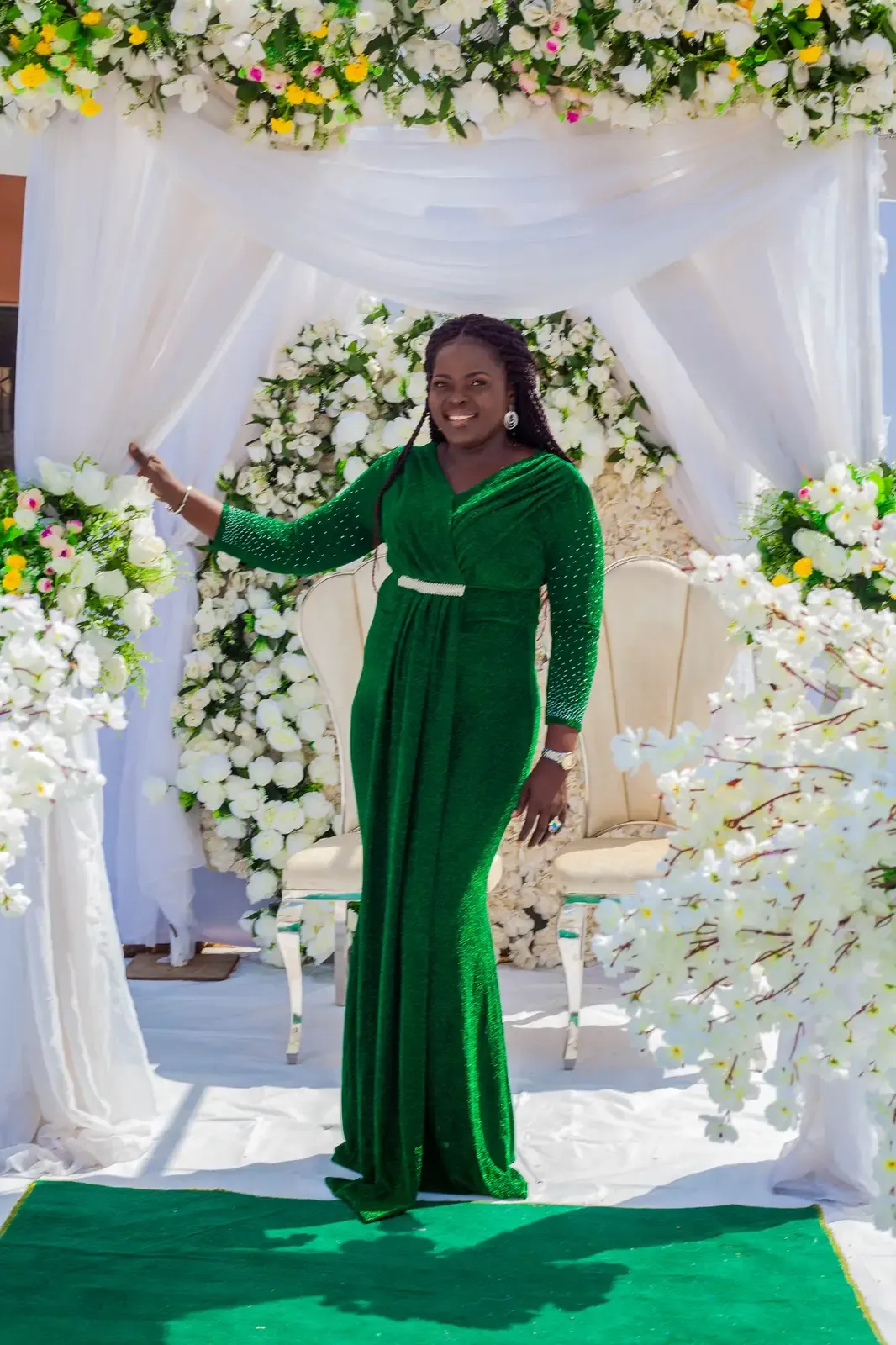
Decoration is the line people find hardest to budget for, and it is easy to see why. Two quotes for what sounds like the same job can differ enormously, and neither planner is necessarily wrong. They are pricing different amounts of work.
Below is what actually moves a decoration number in Ibadan, in roughly the order of how much difference each one makes. None of it is about being expensive or cheap. It is about knowing which decisions cost money and which only feel like they do.
The size of the room decides more than the style
The first thing a decorator is really pricing is volume. A high-ceilinged hall needs taller structures, more drapery and more light to feel finished than a modest one does, and none of that scales gently. A backdrop that reads beautifully at three metres looks lost at six.
This is why a quote can change sharply after a site visit, even when nothing about your brief has changed. The design did not get more elaborate. The room got bigger, and the same design now needs more of everything to hold it.
If you are still choosing between venues, ask what each one will cost to dress before you sign. A cheaper hall that needs twice the decor is not the cheaper option.
Guest count is a decoration cost, not just a catering one
People expect headcount to drive catering. It drives decor just as directly, because most decoration is per-table rather than per-event.
Centrepieces, linen, chargers, glassware, napkins and chair treatments all multiply by the number of tables. Going from 100 guests to 400 does not add a little to the decor budget — it is a different category of job, in the same way it is for catering. We have planned celebrations at 800 guests with zone-by-zone design, and at that point the discipline needed is closer to running a small conference than a party.
Our guide to what a luxury celebration costs goes into how guest count reshapes a whole budget, not just this line.
Focal points cost more than coverage
A room has three or four places where people actually look: the stage or high table, the entrance, the aisle if there is one, and the cake or dessert area. Photographs concentrate there too.
Spending well means putting the budget into those points and letting the rest of the room support them. Spreading the same money evenly across every wall produces a room that looks uniformly decorated and memorably nothing. When a budget is tight, this single decision does more for the result than any other.
Fresh and artificial are a working mix, not a compromise
We use both, and usually together. Fresh flowers give the best texture and scent where guests are close to them — the high table, the cake table, anywhere people stand and look properly. Premium artificial pieces hold their look through a long outdoor event in Nigerian heat and cost considerably less at volume.
The honest answer to "fresh or artificial?" is that it depends on where the piece sits, how long the event runs and whether it is indoors. A tall installation that guests only ever see from six metres away is not where fresh flowers earn their premium.
You can see how this plays out across real events in our gallery, and the approach in more detail on our event decorations page.
Rent what you will not use again
Almost everything that makes a room look expensive can be hired: furniture, charger plates, glassware, lounge seating, lighting, staging, backdrops. Buying it makes sense for a business that will use it fifty more times. For one celebration, hiring is nearly always the cheaper and simpler route, and it removes the problem of what to do with it afterwards.
This is part of why we keep our own decor rentals and tableware inventory. When the styling and the items arrive on one delivery schedule from one company, there is no gap between suppliers who have never worked together, and no second delivery fee.
Install and takedown are real work, and should be in the quote
A quote that covers only the design is not a complete quote. Someone has to install it to the venue's access schedule, and someone has to return afterwards to dismantle and clear the space.
Both are included in our pricing, and it is worth checking explicitly with anyone you are comparing us to. A cheaper number that leaves teardown to you, at midnight, is not cheaper. Ask when the team can get into the venue, too. Access windows shape what is buildable more than most people expect — an elaborate installation is not possible if setup can only begin two hours before guests arrive.
Bring the fabric, not a photograph of it
If your palette has to match asoebi, an invitation or brand guidelines, bring the physical sample to the conversation. Matching to a fabric in hand is far more accurate than matching to a screen, where the same cloth reads two shades off depending on which phone photographed it and what light it was under.
This matters more here than it might elsewhere, because so many celebrations are built around a specific cloth that guests will be wearing. Getting the decor slightly wrong against it is visible in every photograph. It is also worth planning for the fact that traditional and white weddings often sit days apart with different colour stories — they are two design jobs, not one repeated.
Our guide to choosing a colour palette covers how those colours behave under changing light, which is the other half of this decision.
What to ask for when you request a quote
The quickest way to get a quote you can actually compare is to send four things: your date, your venue or the venues you are choosing between, your expected guest count, and a photograph of anything the palette must match.
With those, we can tell you what is achievable, where the money will show, and — honestly — where a plan is trying to do more than the budget supports. A clear budget stated at the start is more useful than a vague one, because it lets us design something that survives contact with reality instead of designing something we later have to strip back.
Ready to plan your next event?
Tell us the date, the venue and roughly how many guests, and we will come back with a decoration plan built around where the money will actually show.